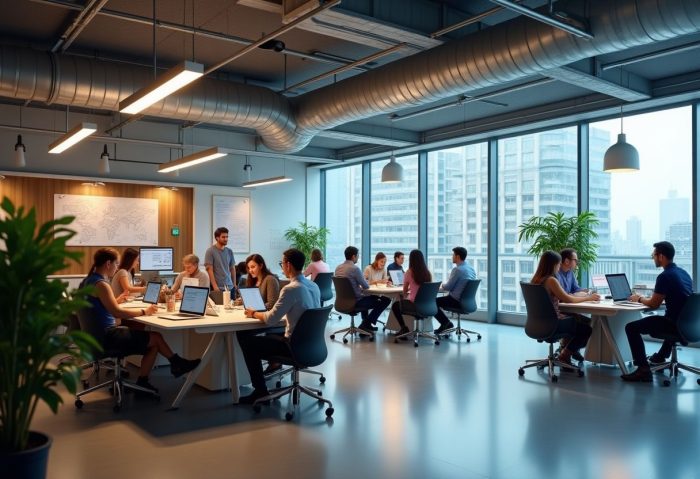
In a constantly evolving professional world, traditional workspaces are transforming. The open space, once a symbol of modernity and collaboration, is now being questioned in light of the rise of remote work and flex office. These new work modalities, accelerated by increasingly powerful digital technologies, are reshaping how employees interact with their work environment. This transformation raises a fundamental question: is the open space compatible with these modern work models? Weighing the pros and cons, it is essential to examine how this structure can adapt to the changing needs of businesses and their employees.
The open space: a conducive environment for collaboration?
The open space was designed to promote communication and collaboration among colleagues. This type of layout, without partitions, allows for easy and direct interaction, thereby reducing barriers between team members.
- Facilitated communication: the absence of walls encourages spontaneous idea exchange. Employees can freely discuss, quickly share information, and thus stimulate innovation.
- Space efficiency: by maximizing the use of every square meter, the open space allows for a large number of people to be accommodated in a reduced area. This can be an economical choice for businesses.
- Visibility and transparency: supervisors can easily observe activities, which can enhance trust and transparency within the company.
The challenges of remote work in an open space
Remote work, now firmly established in professional practices, poses unique challenges when employees must sometimes return to work in open spaces. This dynamic necessitates a reevaluation of how these spaces are designed.
When collaborators return sporadically to the office, the open space can become a source of distractions. Ambient noise and foot traffic can disrupt those who are accustomed to the quiet of remote work. To mitigate these inconveniences, solutions such as noise-canceling headphones or quiet zones can be implemented. Furthermore, integrating remote communication technologies directly into the open space is essential to enable employees to maintain virtual meetings without disturbing their colleagues.
Flex office: adaptation or revolution?
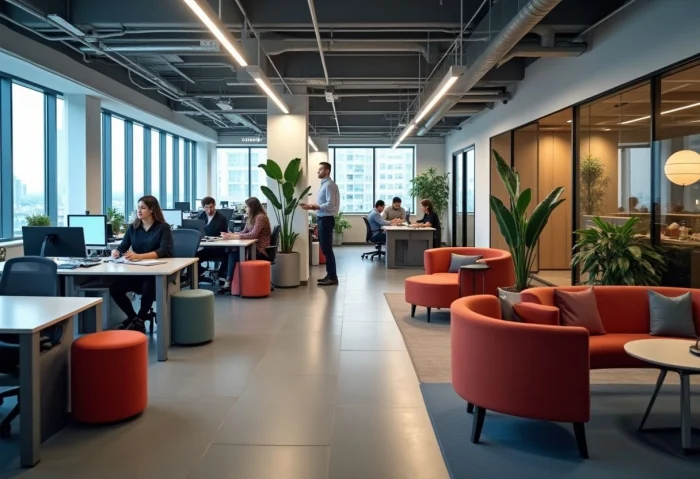
The concept of flex office, characterized by the absence of fixed workstations, is gradually establishing itself in the professional landscape. Companies are adopting this approach to provide greater flexibility to their employees while optimizing space usage.
In a flex office, each day brings the possibility of choosing a new work location based on the tasks to be accomplished. This method encourages engagement and creativity, as employees are not confined to a single desk. However, this flexibility can also lead to some uncertainty. The daily search for an available workstation can be a source of stress. Thus, the implementation strategy must be well thought out, with clearly defined spaces for different activities: quiet areas, conference booths, collaborative spaces, etc. Companies often invest in modular office furniture to adapt to these varied needs.
The impact of new technologies on the open space
Technological advancements have profoundly transformed the way we interact with our work environments. The open space, by integrating these innovations, can reinvent itself to meet the demands of remote work and flex office.
Digital tools such as project management software, instant communication platforms, and cloud storage solutions have enabled employees to stay connected, whether from the office or remotely. These technologies facilitate the transition between working from home and the office. Moreover, the use of smart sensors and real-time data analytics helps optimize workspace usage by identifying employee habits, thus allowing the space to be adapted to actual needs.
As the open space continues to evolve, it is clear that it must adapt to the new expectations of today’s workers. The marriage between technological innovations and the flexibility of layouts is crucial to creating a work environment that is both productive and satisfying for employees. The challenge lies in the ability of companies to leverage the strengths of the open space while minimizing its limitations, in order to create a truly modern and inclusive workspace.