Galeries Lafayette hold a unique place in the French retail landscape. Founded at the end of the 19th century on just a few dozen square meters, they now form a network of 57 stores in France and internationally, including 17 owned and 31 affiliated locations within the national territory. The group claims a total of 310 stores and points of sale across all brands.
Measuring this trajectory requires understanding how a business model has transformed over time, from the haberdashery on Rue La Fayette to the contemporary experiential store.
Size, network, model: Galeries Lafayette in numbers
| Period | Dominant Model | Network | Notable Event |
|---|---|---|---|
| 1893-1912 | Direct ownership, real estate expansion | One main store (Boulevard Haussmann) | Opening of a haberdashery on Rue La Fayette, gradual acquisition of neighboring buildings |
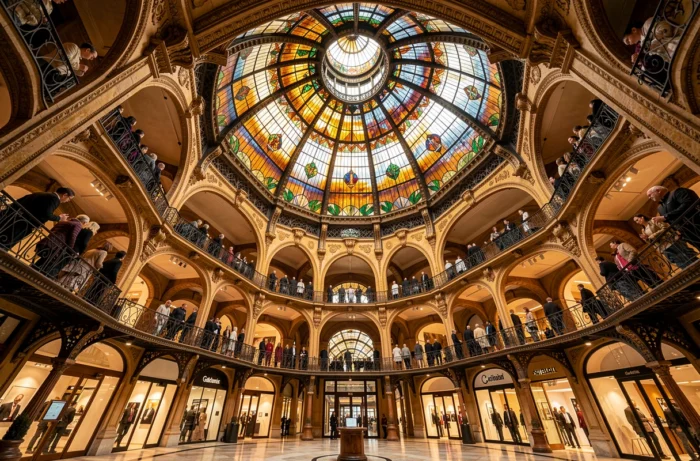
| 1912-1960 | Integrated department store, centralized purchasing | Few points of sale in France | Inauguration of the neo-Byzantine dome and monumental staircase |
| 1960-2000 | National expansion through branches | Dozens of stores in regions | Democratization of fashion, opening to new product categories |
| 2000-present | Hybrid: owned stores, affiliation, international | 57 stores (17 owned, 31 affiliated in France) + 310 points of sale across all brands | Upmarket positioning, omnichannel, role as a prescriber for young designers |
The original model relied on the ownership and direct operation of a single site. In a century, the structure has shifted to a hybrid system combining affiliation, owned stores, and international presence. Tracing the history and evolution of Galeries Lafayette helps to understand how each shift has altered the relationship between the brand and its clientele.
Foundation and architecture: what the Haussmann dome reveals about the initial project
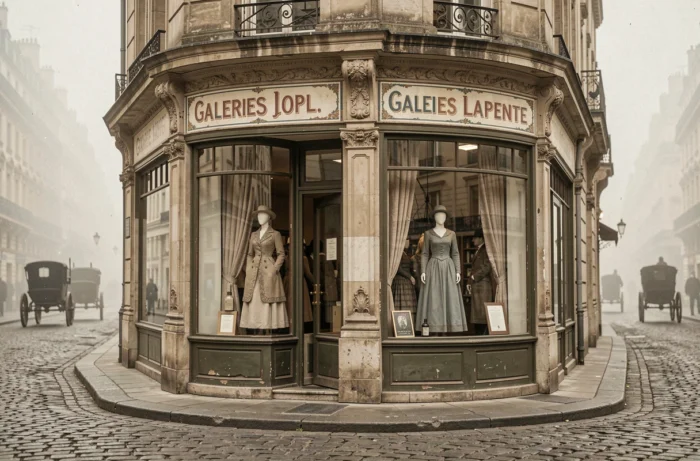
Théophile Bader and Alphonse Kahn opened a small novelty store in 1893 at the corner of Rue La Fayette and Rue de la Chaussée d’Antin. The choice of this location is due to its strategic position, between the Opéra Garnier, Gare Saint-Lazare, and the Grands Boulevards, a crossroads that ensures a dense pedestrian flow.
The name “Aux Galeries Lafayette” simply comes from the address of the original premises.
The real estate expansion happened quickly, with the acquisition of neighboring buildings. Architect Ferdinand Chanut designed a building whose neo-Byzantine glass and steel dome became the emblem of the place. More than just an ornament, this dome embodies a commercial intention: to transform shopping into a visual spectacle, in a context where Parisian department stores compete in architectural boldness to capture the attention of the crowds.
The department store as a flow machine
Interior balconies open onto the central void, tiered floors: the structure of the Haussmann building is designed to guide the gaze downward and provoke a natural vertical circulation. This principle of spatial staging draws on the heritage of Parisian covered passages, but on a scale and with a theatricality that distinguishes Galeries Lafayette from Printemps or Bon Marché.
Democratization of fashion and advertising: the turn of the 20th century
From the beginning of the 20th century, Galeries Lafayette did not limit itself to selling products. They participated in the democratization of fashion in France by making trends from fashion houses accessible, in a setting that values the act of purchasing itself.
Advertising is a central lever of this strategy. Posters, illustrated catalogs, animated windows: the brand positions itself as a cultural player, not just a commercial one. This approach sets it apart from popular bazaars, whose argument is limited to low prices.
- Artist posters distributed in the metro and the press, establishing a recognizable visual identity long before the era of modern branding
- Thematic windows refreshed each season, making Boulevard Haussmann a curiosity trail in its own right
- Mail-order catalogs allowing access to provincial customers, well before online commerce
This setup has built a reputation that goes beyond mere retail. The Haussmann store is among the most visited sites in Paris, on par with some monuments.
Galeries Lafayette today: from sales store to experience venue
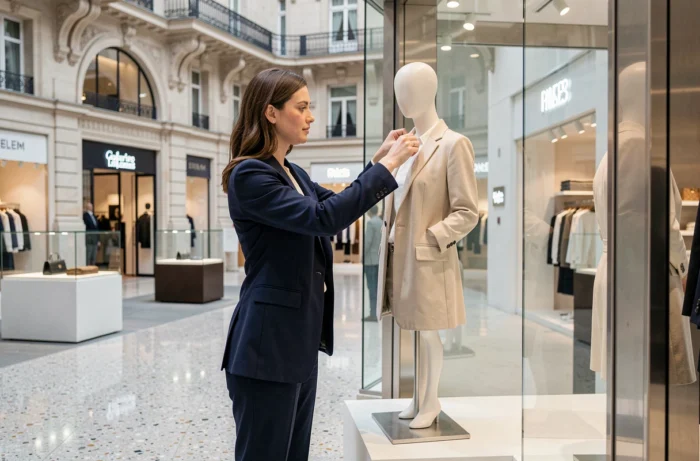
The physical store is no longer just a transaction space. It has transformed into a place for services, advice, and experience, a direct response to the competition from online commerce that has reshaped consumer expectations.
The completed renovations at the Haussmann store illustrate this upmarket shift. The brand is deploying higher presentation standards throughout its French network, with a clear objective: to maintain the attractiveness of physical points of sale in the face of the convenience of digital.
Prescriber for young fashion creators
Galeries Lafayette have structured a role in talent detection. The partnership with ANDAM, active since 2003, and dedicated spaces like the Maison des Créateurs allow for support of emerging designers. This function as a prescriber for the fashion of tomorrow differentiates the brand from a classic multi-brand distributor.
- Partnership with ANDAM since 2003 to support young French and international creators
- Maison des Créateurs: a space within the Haussmann store functioning as a showcase for developing brands
- Omnichannel journey integrating human advice in-store and digital tools to extend the shopping experience
The current hybrid model, between owned stores, affiliation, and international presence, reflects a permanent adaptation to the economic constraints of the sector. From the haberdashery of 1893 to the current network of 310 points of sale, the common thread remains the ability to redefine what a commercial space offers to its audience, beyond merely providing products.