
An ecological construction or comprehensive energy renovation project starts with a simple question: who to turn to for reliable, non-commercial advice? Since the reform of MaPrimeRénov’ that came into effect in 2024, the answer to this question is partly regulatory. The involvement of certain approved professionals now conditions access to public aid for large-scale projects.
My Renovation Guide: a regulatory step before any on-site contact
Before seeking a specialized architect or a thermal engineering firm, a preliminary step is required for any large-scale renovation project. Since January 1, 2024, the use of an approved Renovation Guide is mandatory to access the supported pathway of MaPrimeRénov’, which funds comprehensive renovations aimed at achieving at least two energy class improvements.
Without this guide, the application is simply not processed by the Anah, even if the project is technically sound. This approved professional intervenes upstream: they conduct an energy audit, propose a coherent work plan, and oversee the construction site until completion.
To identify a guide in your department, the official France Rénov’ directory remains the most direct entry point. Some organizations specializing in sustainable housing also offer comprehensive support on bio-based materials and ecological construction techniques. For example, you can contact Habite Ta Terre! to discuss a project focused on ecoconstruction.
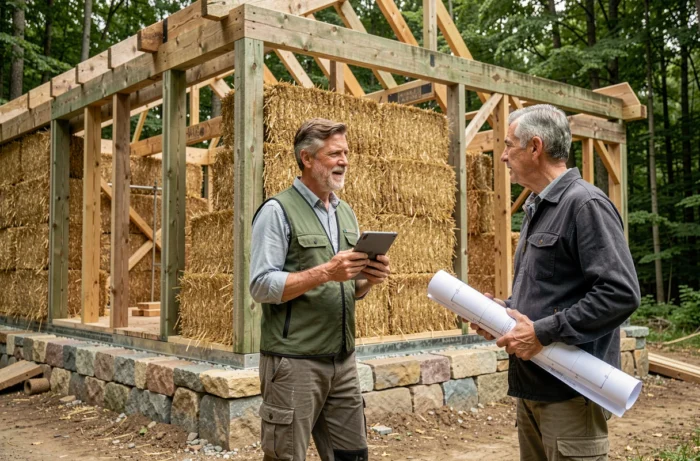
Free France Rénov’ Advisor: the first filter before choosing an expert
The France Rénov’ network provides advisors whose role is often misunderstood. They are neither salespeople nor craftsmen. Funded by the State, ADEME, and local authorities, they offer neutral, free advice independent of any construction company.
Their usefulness is twofold. First, they guide you to the right contacts based on the nature of the project (energy renovation, new construction with ecological materials, housing adaptation). Second, they clarify the available aid schemes before the owner commits to a professional.
How to contact them concretely
- The national number 0 808 800 700 (free call) allows for an initial phone exchange to frame the project and obtain the contact details of the local advisory space
- The France Rénov’ advisory spaces hold physical sessions in most intercommunalities, sometimes directly funded by the local authority
- The website france-renov.gouv.fr offers a geolocated directory of advisors and approved guides by department
This first free contact avoids a common mistake: directly soliciting an RGE craftsman or a study office without having verified the project’s eligibility for aid, nor defined the actual scope of the work.
Finding an expert in ecoconstruction outside the traditional renovation circuit
The France Rénov’ advisors and Renovation Guides cover the energy renovation aspect well. However, for a new ecological construction project (rammed earth, straw, solid wood, hemp), the circuit is different.
The sought-after skills are not the same. An expert in ecological housing understands the hygrothermal properties of bio-based materials, specific implementation techniques (earth plasters, braced wooden frames, straw bale insulation), and the regulatory constraints related to RE 2020.
Specialized networks and directories to prioritize
Regional ecoconstruction associations often bring together architects, craftsmen, and study offices trained in bio-based and geo-based materials. Their directory allows you to identify professionals whose competence goes beyond simple RGE certification.
Professional fairs and local events (ecoconstruction fairs, open days for participatory projects) remain a direct contact channel with practitioners. Face-to-face exchanges allow for a quick assessment of a contact’s technical mastery, which an online form cannot replace.
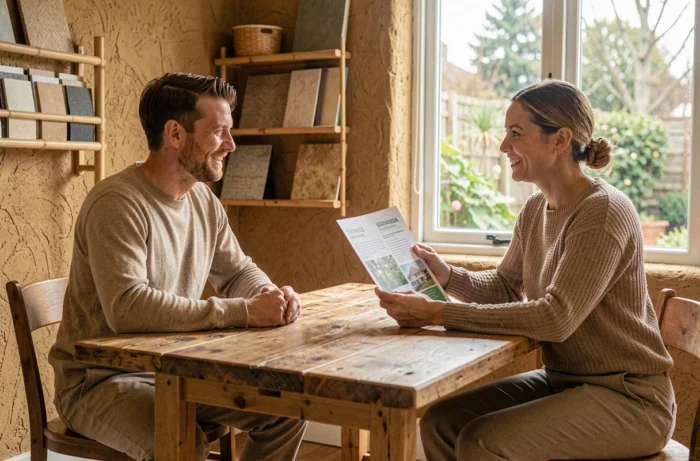
Criteria for assessing the reliability of a sustainable housing expert
Getting in touch with a professional is one thing. Verifying their actual competence is another. A few concrete checkpoints can help filter contacts before committing.
- RGE qualification alone does not guarantee expertise in ecoconstruction. It certifies competence in energy performance, not in ecological materials. An RGE craftsman can very well install glass wool insulation without knowing the behavior of hemp or cellulose wadding
- A thermal engineering office specialized in ecological housing should be able to provide references for projects similar to yours, with comparable materials and techniques
- Membership in a recognized professional network (ecoconstruction associations, collectives of architects engaged in sustainable construction) serves as a more reliable indicator of specialization than a simple mention on a website
- The ability to explain technical choices (why choose wood fiber over polystyrene, what impact on summer comfort) distinguishes an expert from a mere installer
A good first contact is also measured by the quality of the questions asked by the professional. A competent expert starts by questioning the uses and existing structure before proposing solutions.
The path to contacting a specialist in ecological housing therefore depends on the type of project. For a comprehensive energy renovation, the route now goes through France Rénov’ and an approved Renovation Guide. For new construction with bio-based materials, specialized associative networks and direct contact during events remain the most relevant channels. In both cases, the free initial public advice eliminates the risk of engaging too quickly with an ill-suited contact for the project.