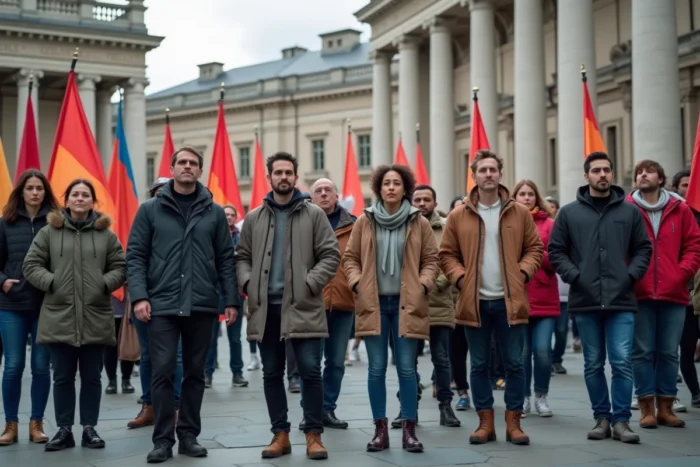
The Universal Declaration of Human Rights was adopted in 1948, but more than 70 years later, violations persist everywhere in the world. No country has an impeccable record, even those that present themselves as models.
Laws meant to protect freedoms can sometimes be used to restrict expression or mobilization. Young generations, who are primarily affected, often remain on the sidelines of debates and actions. Despite the urgency, the commitment to these fundamental rights relies on constant mobilization and appropriate education.
Why Human Rights Are Essential to Our Societies
Recent history reminds us: fundamental rights are anything but an optional extra for our societies. They form the very foundation that guarantees stability, freedom, and respect for everyone’s dignity. In 1948, in Paris, the Universal Declaration of Human Rights, championed by Eleanor Roosevelt and the United Nations, established a common ground. This text, often cited but sometimes forgotten in practice, remains a line of defense against arbitrariness, institutional violence, and discrimination.
The Universal Declaration does not stop at general principles. Each of its articles concretely engages: accessible justice, freedom of thought, equality before the law. The right to education, health, and safety… These concepts shape the lives of millions of people every day. Liberty, equality, dignity: this triptych, engraved in the French motto, asserts itself wherever human rights are at stake.
Three realities emerge when talking about the defense of rights:
- The protection of rights and freedoms must be earned and maintained daily; nothing is ever guaranteed.
- Being attentive to threats, even subtle ones, remains a requirement for everyone, generation after generation.
- Civil society and citizen engagement play a structuring role in preserving these achievements.
To stay informed about human rights issues, vigilance proves invaluable. Libereco sheds light on the links between the economy, public policies, and fundamental freedoms. A useful resource for understanding the world’s developments and acting with knowledge.
Who Can Act to Defend Fundamental Freedoms?
The defense of human rights is not reserved for specialists or media figures. In truth, everyone has a role to play: employee, student, teacher, caregiver, artist… All can become actors, sometimes without having premeditated it. Often, the impetus comes from a blatant injustice, an urgency, or builds over time through engagement in a civil society organization or the creation of a collective.
In Europe, numerous initiatives prove this: campaigns for freedom of expression in France, mobilizations for political prisoners in Iran, local or international actions… Engagement takes a thousand forms and reveals unsuspected energy. Citizen collectives, unions, lawyers, or ordinary citizens who refuse to remain silent all strengthen democratic vitality.
Here are some concrete examples of engagement:
- Whistleblowers reporting violations: they act in the interest of all, often at the risk of their own safety.
- Teachers imparting the values of the Universal Declaration: they sow the seeds of vigilance and responsibility.
- Investigative journalists documenting abuses: they shed light on what others would prefer to keep in the shadows and contribute to the protection of all.
The defense of human rights requires opening our eyes and rejecting resignation. Thanks to social media, it is now possible to alert, organize campaigns, and support those who are threatened, here and elsewhere. Engagement takes a thousand voices, driven by the certainty that letting go of freedom, equality, or dignity is never an option.

Passing the Flame: Raising Awareness and Educating Young People About Human Rights
Incorporating human rights into education is not an extra; it is a necessity. Human rights education is included in school curricula, animates classroom debates, and nourishes associative projects. It equips young people to recognize, understand, and denounce violations of dignity and freedoms. Teachers, educators, volunteers: all play the role of watchful guardians, transmitting the Universal Declaration with rigor and commitment, without dogmatism.
Awareness-raising never starts too early. From middle school, workshops, mock trials, or concrete situational exercises allow students to grasp what it means to defend a threatened right, act for others, and understand that solidarity does not stop at a word. Here, knowledge is not transmitted top-down; experience, debate, and encounters with engaged defenders are created, sometimes involving former students who return to share their associative or volunteer commitments.
This awareness takes different forms:
- Discovering the reality of rights protection in various countries, from the Middle East to Europe, develops critical thinking.
- Participating in volunteer actions connects theory to practice, giving meaning to engagement.
Promoting human rights among young people is about fostering a generation that refuses indifference. Each new wave of citizens then becomes a living bridge between memory and action, vigilance and transmission. Nothing is ever fixed: the defense of human rights plays out every day, in every gesture, every spoken word, every educational choice. The flame only needs to be rekindled.