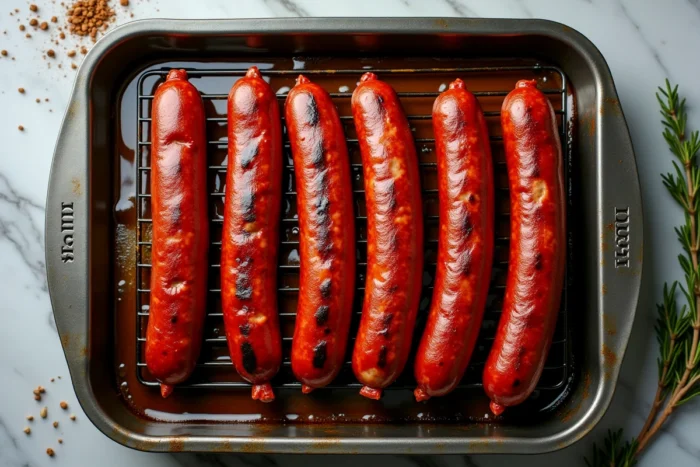
Baking merguez in the oven provides an enveloping heat that cooks the sausage evenly, without requiring constant supervision or frantic flipping. The result depends less on technique than on the chosen cooking rack and settings.
Perforated tray and air circulation: the true technical lever in the oven
The rack on which the merguez rests during cooking directly influences the final texture, even more so than temperature or timing.
Placing merguez flat in a traditional dish causes melted fat to accumulate at the bottom. The sausages then bathe in their own juices, which softens the casing instead of searing it. The final texture resembles more of a poached merguez than a grilled one.
Professional cooking guides, especially those aimed at collective catering, recommend using a perforated tray or a rack placed over a drip tray. This setup allows hot air to circulate underneath and around each sausage. The fat drains away, the casing dries on the surface and develops a slight coloration, while the inside remains juicy. Mastering the cooking of merguez in the oven starts with this choice of rack before any other consideration.
In convection heat, the effect is even more pronounced. The fan accelerates surface evaporation and creates an environment similar to a professional convection oven. If your oven does not have this function, a standard oven rack (the one used for casseroles) placed on the drip tray does the job.
Oven temperature and cooking time for merguez
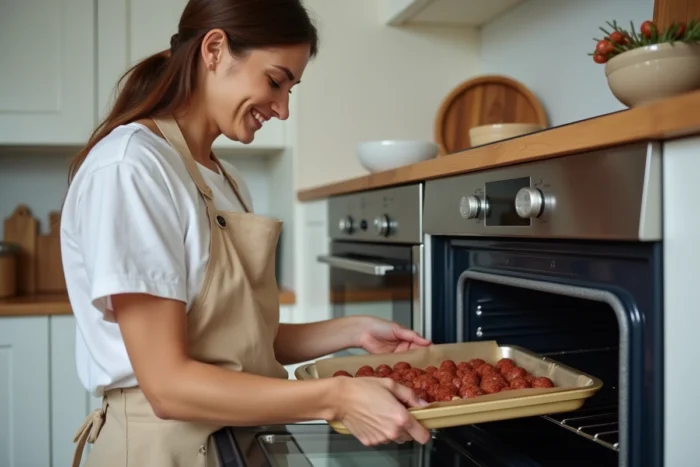
The classic guidelines revolve around 180 °C and a quarter of an hour of cooking. These benchmarks work, but they mask several variables.
Convection heat or static heat
In convection heat, the temperature felt by the food is higher than in static mode at the same setting. Lowering by 10 to 20 degrees compared to the classic mode prevents the casing from retracting too quickly and bursting. Preheating the oven remains a non-negotiable step: baking in a cold oven extends cooking time and results in a greasy finish.
Thickness and caliber of the merguez
A large-caliber artisanal merguez does not cook at the same rate as a thin supermarket merguez. Thick merguez require a longer cooking time at a slightly lower temperature, so the center reaches full cooking without charring the outside.
The merguez must be brought to a complete cooking at the core, according to the hygiene best practices guide for the butchery profession. Serving a merguez that is pink in the center is considered non-compliant. This point mainly concerns collective catering, but it is worth keeping in mind at home, especially when cooking for children or vulnerable individuals.
Should you prick the merguez before baking in the oven?
The debate over pricking merguez has been ongoing in forums and kitchens for years. Field reports vary on this point, and professionals themselves do not all agree.
The argument in favor of pricking: allowing steam to escape to prevent the casing from bursting under pressure. The argument against: each hole lets out juice and fat, which dries out the meat.
In the oven, the temperature rise is more gradual than on the barbecue or in a pan. The casing has time to expand without undergoing a sudden thermal shock. Not pricking the merguez in the oven generally results in a juicier outcome, provided a reasonable temperature is maintained and the sausages are spaced correctly on the rack.
If the casing bursts anyway, it is often a sign of too high a temperature or a poorly preheated oven compensating with overheating.
Premium ranges and some Label Rouge merguez are made with a slightly thicker casing designed to withstand oven cooking without bursting. The thickness of the casing varies by range, affecting both heat retention and mouthfeel.
Merguez in the oven: common mistakes and checkpoints
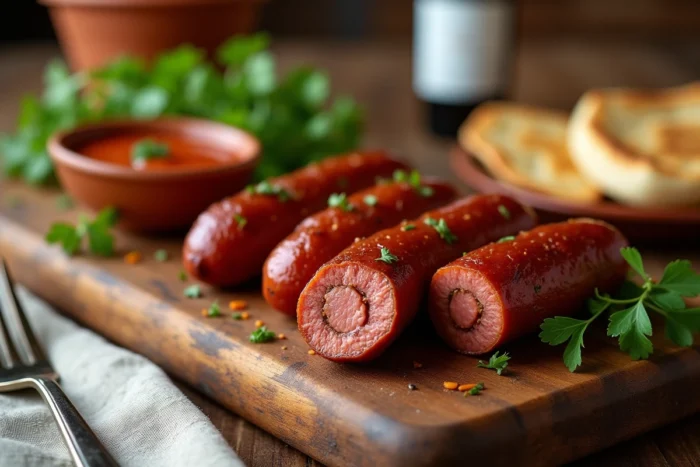
Some mistakes consistently occur and explain the majority of dried-out or bland merguez coming out of the oven.
- Sticking the merguez against each other in the dish. Without space between them, heat does not circulate, and cooking becomes uneven. Leave at least one centimeter between each sausage.
- Forgetting to turn the merguez halfway through cooking. Even on a rack, the side in contact with the support cooks differently. A single flip is enough to achieve a uniform coloration across the entire surface.
- Adding oil to the dish. The merguez contain enough fat not to stick. Added oil causes splatters and smoke without improving the result.
- Extending cooking time to achieve a darker color. The coloring in the oven is less intense than on the barbecue. Seeking the same visual results in overcooked meat.
Side dishes and sauce: making the most of the cooking juices
The juices collected in the drip tray under the rack are not waste. This mixture of fat and meat juices can serve as a base for a quick sauce.
Strain the juices to remove excess fat, then deglaze in a small saucepan with a splash of mustard and a spoonful of honey. This mustard-honey mixture enhances the merguez without masking them, and emulsifies easily with the hot juice. The spices already present in the merguez (cumin, chili, coriander) naturally pair with the acidity of the mustard.
For side dishes, chopped vegetables can cook directly on the drip tray, under the merguez rack. The draining fat flavors them during cooking. Bell peppers, zucchini, and onions work particularly well with this method.
Cooking merguez in the oven does not replicate the smoky flavor of the barbecue, and that is not its goal. It offers a consistency and practicality that other methods do not achieve, especially when cooking for a group. Using a rack, preheating properly, and adjusting the cooking time to the caliber of the sausages is enough to achieve a consistent and juicy result.