In the kitchen, juggling between different units of measurement can quickly become a headache. Whether it’s to successfully make that American recipe that calls for ‘cups’ or to adapt a recipe based on the utensils available, knowing how to convert volumes is a valuable skill.
Imagine preparing a delicious cake and realizing that you don’t have a measuring cup on hand. No worries! With a few simple tips and practical benchmarks, you can easily transform milliliters into cups, ounces into liters, or tablespoons into grams. In no time, you’ll master these conversions and gain confidence in the kitchen.
The Basics of Volume Units in Cooking
To navigate smoothly between the various volume units in cooking, it’s important to know a few basic conversions. The most common unit of measurement is the milliliter (ml). Did you know that one milliliter is equivalent to 0.001 liters? This simple relationship makes it easy to convert between these two units.
The centiliter (cl) is another unit frequently encountered, especially in European recipes. One centiliter is equivalent to 10 milliliters. For example, 400 ml converted to cl gives 40 cl. This conversion is useful for adapting recipes based on the tools available.
| Unit | Equivalence |
|---|---|
| 1 liter | 1000 milliliters |
| 1 centiliter | 10 milliliters |
| 1 deciliter | 100 milliliters |
| 1 cup | 240 milliliters |
| 1 tablespoon | 15 milliliters |
| 1 teaspoon | 5 milliliters |
These conversions are essential to ensure the accuracy of recipes. For example, one cup is equivalent to 240 milliliters, while one tablespoon represents 15 milliliters. Using incorrect units can compromise the final result. Familiarize yourself with these equivalences to avoid mistakes.
Fluid ounces, often used in Anglo-Saxon recipes, convert easily: one fluid ounce is equivalent to 29.57 milliliters. Knowing these conversions simplifies adapting foreign recipes. 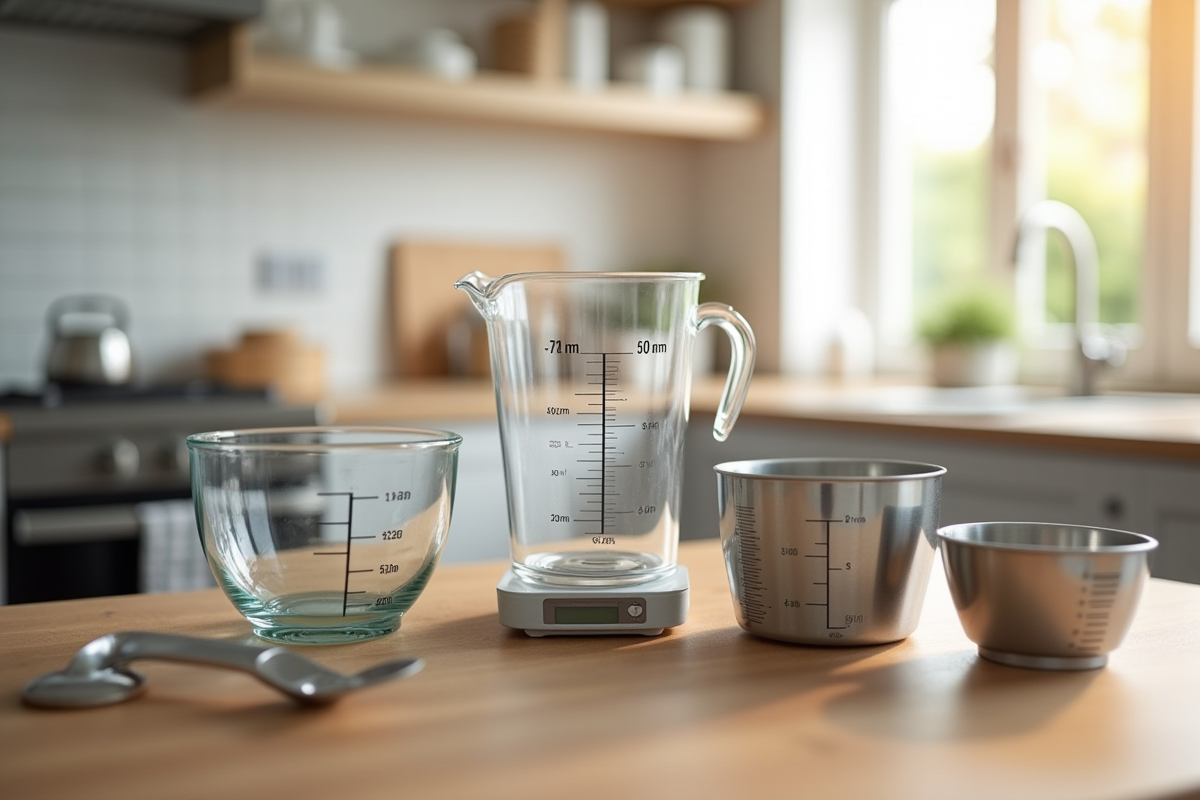
Practical Tips and Examples for Easily Converting Volumes
To convert volumes in cooking accurately, several tips and tools can simplify the task. Whether you’re a chef or a home cook, mastering these techniques is essential for ensuring optimal results.
Use Appropriate Tools
To ensure precise measurements, use graduated utensils such as:
- Measuring cups
- Graduated spoons
- Digital scales
These tools facilitate conversions, especially for liquid and dry ingredients.
Conversion Tables
Always keep a conversion table handy. This allows for quick conversion of common units. A few examples:
| Unit | Equivalence |
|---|---|
| 1 cup | 240 milliliters |
| 1 tablespoon | 15 milliliters |
| 1 teaspoon | 5 milliliters |
Online Converters
Online converters are valuable tools. They allow you to convert volumes in just a few clicks, thus avoiding calculation errors. These are particularly useful for adapting international recipes.
Practical Examples
Let’s take a concrete example: for a recipe requiring 500 milliliters of milk, use a graduated measuring cup to accurately measure this amount. If the recipe calls for 2 tablespoons of oil, know that this corresponds to 30 milliliters. Using precise measurements ensures a result that meets expectations.
By following these tips and using the appropriate tools, you can convert volumes in the kitchen with increased accuracy.