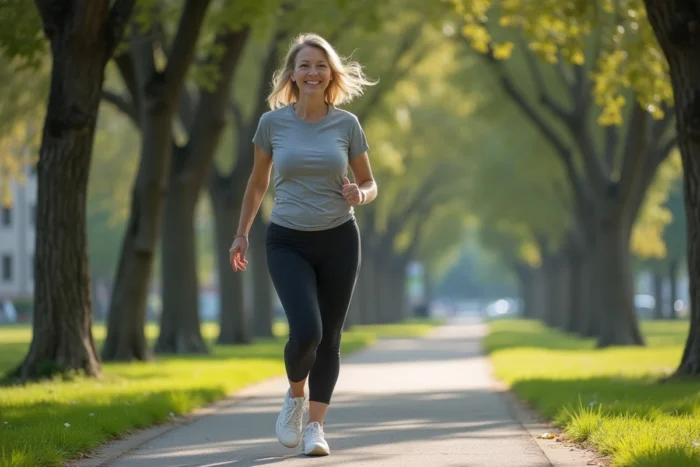
Walking at a pace that is too slow does not offer the same benefits as maintaining a moderately brisk pace. According to several studies, every increase of 0.1 km/h in walking speed can reduce the risk of all-cause mortality. Yet, many adults are unaware that the ideal pace varies according to age, fitness level, and health goals.
Official recommendations suggest an optimal speed range, but individual responses are often overlooked. Adjusting one’s pace allows for the optimization of cardiovascular, muscular, and metabolic outcomes while minimizing the risk of injury.
Why does walking speed really influence your health?
Walking speed is a game changer, much more than one might suspect. It impacts heart health, aids in the prevention of chronic diseases, improves endurance, and affects weight management. Transitioning from a slow walk to a more vigorous pace tests the cardiovascular system, burns more calories, stimulates endorphin production, and targets the energy deficit useful for weight loss.
Scientific studies are clear: adopting a brisk walk decreases the risk of type 2 diabetes and helps better control cardio-metabolic risk factors. Interval walking, alternating fast and slower phases, multiplies the effects: it engages reserves differently, maintains the pleasure of effort, and amplifies benefits.
To find your way and adjust your practice, it’s best to listen to your sensations and choose an intensity suited to your abilities. A few minutes of dynamic walking each day, integrated into a physical activity routine, add up over time. If you want to refine your benchmark and identify your ideal normal walking speed, Valbreon’s health tips provide concrete guidance: adjust your efforts, find the right balance between efficiency and pleasure, and make walking a solid ally for your overall health.
How to recognize your ideal walking speed based on age and fitness level
Determining your ideal walking speed involves paying attention to your body: breath, recovery, muscle sensations. Age, current fitness level, and activity habits all matter. An adult accustomed to regular movement can easily reach 5 to 6 km/h at a good pace: it’s brisk, stimulating, but not excessive.
For others, especially seniors or those who do not walk often, a pace of 3 to 4 km/h remains suitable. This speed helps maintain endurance and easily fits into daily life. The best indicators? Feeling comfortable, being able to talk without being out of breath, and progressing without discomfort.
Practices also influence pace. In Nordic walking or race walking, speed increases, exceeding 6 km/h due to more advanced technique and increased muscle engagement. In hiking, the terrain dictates the pace: elevation slows you down, and the duration of effort takes precedence over pure speed.
To gauge your own pace, it’s simple: measure your time over a known distance, analyze your sensations after ten minutes, then adjust according to fatigue or breathlessness. This method, accessible to everyone, allows for personalized walking, whether you are a beginner or experienced.

Practical tips to improve your walking speed and reap all the benefits
Improving your walking speed involves a few simple habits. Before each session, give yourself a warm-up of at least five minutes: articulate your ankles, gradually increase your pace, and wake up your muscles. This time reduces the risk of injury and prepares the body for effort. The choice of shoes is important: opt for a pair suited for walking or running, with good cushioning and a flexible sole. Your comfort over time directly depends on this.
Varying your routes stimulates the body. Consider incorporating different surfaces: flat, stairs, slopes. This mix develops endurance, engages new muscle groups, and increases energy expenditure. To go further, try interval walking: alternate fast segments of one to two minutes with slower phases. This principle energizes your physical fitness, encourages weight loss, and maintains heart health.
To help you stay on track, here are some tools and habits to adopt:
- Use a pedometer, a smartphone app, or a GPS watch to visualize your progress and stay motivated.
- Make sure to stay hydrated: before, during, and after walking, water supports effort and recovery.
- On the nutrition side, focus on balanced meals: fiber, protein, complex carbohydrates to support energy and recovery.
Finally, recovery should not be overlooked. A few minutes of stretching at the end of your walk prevent soreness and maintain flexibility. Walking, practiced regularly, establishes itself as a complete physical activity, beneficial for body shape and overall well-being. It’s not performance that matters, but consistency: session after session, even at a moderate pace, your body evolves, health follows, and each step counts a little more.